DSCFO

Click image to view full screen

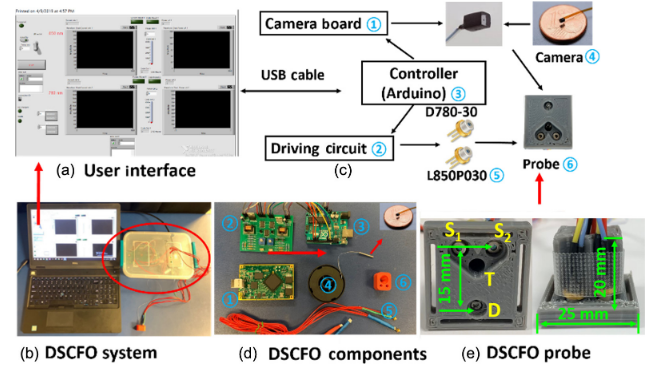
Fig. 1: Dual-wavelength DSCFO system for deep tissue blood flow and oxygenation measurements. (a) The GUI of the DSCFO device. (b) The DSCFO system, including a laptop and the DSCFO device. (c) A schematic of DSCFO. (d) Components in the DSCFO device including camera electronic (NanEye USB 2.0) ①, laser diodes driving circuit ②, Arduino controller ③, NanEye camera ④, laser diodes ⑤, and DSCFO probe ⑥. (e) The wearable 3D-printed DSCFO probe. Two laser diodes (S1: 780 nm, 30 mW and S2: 850 nm, 30 mW) work as the dual-wave-length sources. The NanEye camera (D) works as a 2D detector array. The thermistor resistor (T) works as a thermal sensor to detect skin temperature. The probe dimensions are 25 × 25 ×20 mm3. The S-D distances are 15 mm.

(Liu, Xuhui, et al. “Simultaneous measurements of tissue blood flow and oxygenation using a wearable fiber-free optical sensor.” Journal of Biomedical Optics 26.1 (2021): 012705-012705.)
DSCFO

Diffuse Speckle Contrast Flow-Oximetry (DSCFO). Supported by the NIH, we have developed an innovative, low-cost, fiber-free, wearable diffuse speckle contrast flow-oximetry (DSCFO) probe with varied dimensions/sizes, which affixes to heads of animals (mice, rats, piglets) and human newborns for continuous cerebral blood flow (CBF) and cerebral blood oxygen saturation (StO2) monitoring during naturally behavioral conditions. DSCFO uses small laser diodes at different near-infrared wavelengths as point sources for noninvasive deep tissue penetration (up to ~10 mm depth) and a tiny CMOS camera as a high-density 2D detector array to detect spatial diffuse laser speckle fluctuations, resulting from movement of red blood cells in the brain (i.e., CBF). Alternative measurements of light intensity attenuations at different wavelengths enable quantification of StO2 using near-infrared spectroscopy principle. Importantly, connections between the wearable DSCFO probe and a portable device are all flexible electrical wires (i.e., fiber-free), allowing for continuous cerebral monitoring in freely behaving subjects.

Click image to view full screen

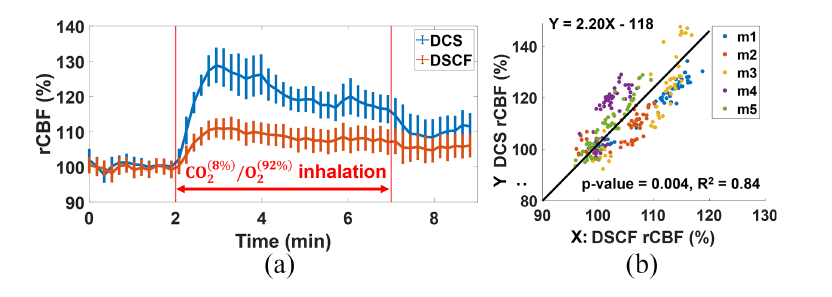
Fig. 2: Concurrent DCS/DSCF measurement of hemodynamic changes in anesthetized mice (n = 5) during CO(8%)2 /O(92%)2 inhalation.  (a) Average time-course changes of rCBF before, during, and after CO2 inhalation measured by DCS/DSCF. Error bars represent standard error over the 5 mice. (b) Correlation between DCS and DSCF measurements of rCBF from the 5 mice.

(Liu, Xuhui, et al. “A wearable fiber-free optical sensor for continuous monitoring of cerebral blood flow in freely behaving mice.” IEEE Transactions on Biomedical Engineering 70.6 (2022): 1838-1848.)

Click image to view full screen

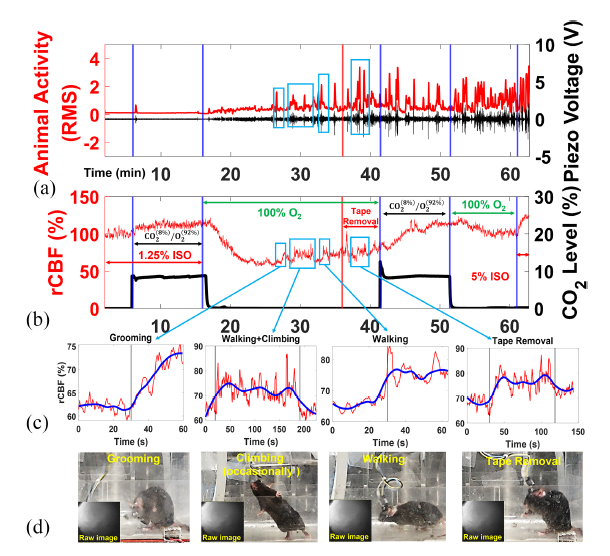
Fig. 3: Continuous rCBF and behavior monitoring in a representative mouse under anesthesia and awake conditions. (a) Animal activity level (red curve) from the RMS of piezoelectric cage floor signals (black curve). (b) rCBF (red curve) and CO2 concentration (black curve) were continuously monitored by a wearable DSCF head-stage/ probe (S-D distance: 6 mm) and CO2 sensor on the cage floor, respectively. “%ISO” denotes the percentage and periods of isoflurane application. (c) Corresponding rCBF responses (red curve) during grooming, occasional climbing, walking, and tape removal with representative trends using
a moving average (blue curve). (d) Raw NanEye camera images and external Canon video recordings in the grooming, climbing, walking, and tape removal periods.

(Liu, Xuhui, et al. “A wearable fiber-free optical sensor for continuous monitoring of cerebral blood flow in freely behaving mice.” IEEE Transactions on Biomedical Engineering 70.6 (2022): 1838-1848.)

Click image to view full screen

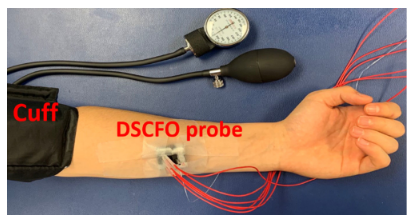
Fig. 4: DSCFO measurements of Δ[Hb], Δ[HbO2], and rBF in the forearm during artery cuff occlusion on the upper arm. A wearable DSCFO probe was fixed on the forearm using medical tapes. An inflatable cuff was installed on the upper arm for artery occlusion.

(Liu, Xuhui, et al. “Simultaneous measurements of tissue blood flow and oxygenation using a wearable fiber-free optical sensor.” Journal of Biomedical Optics 26.1 (2021): 012705-012705.)
Click image to view full screen

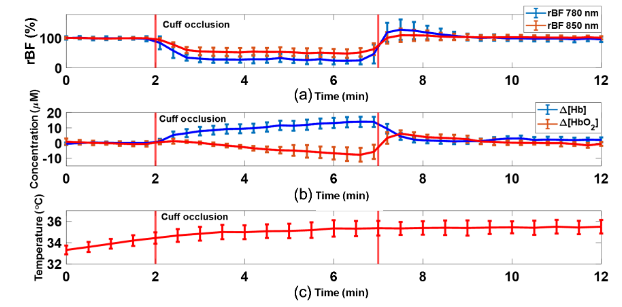
Fig. 5: Average hemodynamic changes during artery cuff occlusion measured by the DSCFO over five subjects. (a) Average rBF responses to artery occlusion induced by an inflation pressure of 220 mmHg. (b)Average Δ[Hb] and Δ[HbO2] responses to artery cuff occlusion.(c) Temperature variations on skin surface during experiments. The error bars represented the standard deviations over five subjects.

(Liu, Xuhui, et al. “Simultaneous measurements of tissue blood flow and oxygenation using a wearable fiber-free optical sensor.” Journal of Biomedical Optics 26.1 (2021): 012705-012705.)
Click image to view full screen

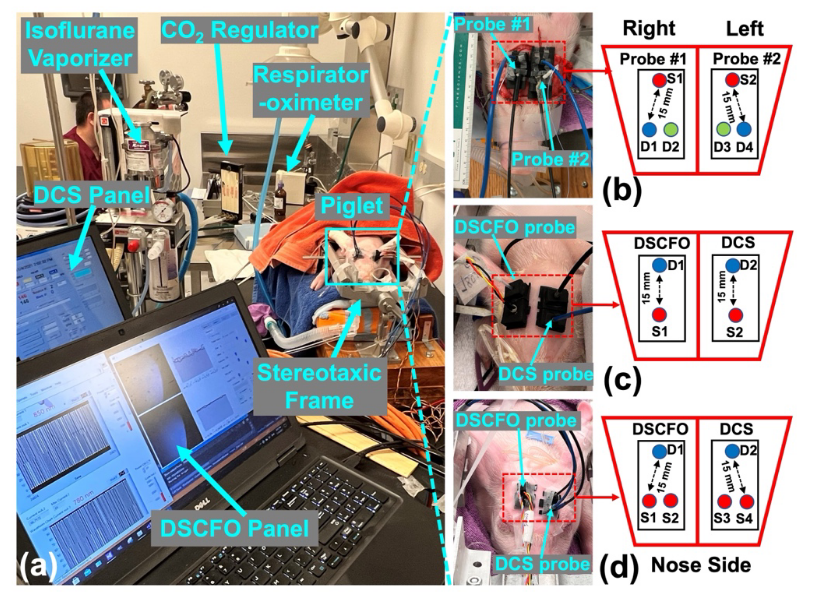
Fig. 6:  Continuous monitoring of cerebral hemodynamics in neonatal piglets using different DSCFO and DCS probes. (a) Experimental setup for continuous monitoring of multiple physiological parameters in a neonatal piglet.(b)Two hybrid probes (Probe #1 and Probe #2) installed on the intact skull of right and left hemispheres of Piglet #1, respectively. Each probe consisted of one DCS source (S1 or S2: 785 nm long-coherence laser, CrystaLaser) and two detectors (D1 or D4: NanEye cameras; D2 or D3: APDs in DCS).(c) A single-wavelength DSCFO and a single-wavelength DCS probes installed on the scalp of right and left hemispheres of Piglet #2, respectively. The DSCFO probe consisted of one source (S1: 785 nm laser diode, Thorlabs) and one detector (D1: NanEye camera). The DCS probe had one source (S2: 785 nm long-coherence laser, CrystaLaser) and one detector (D2: APD).(d) A dual-wavelength DSCFO and a dual-wavelength DCS probes installed on the scalp of right and left hemispheres of Piglet #3 and Piglet #4, respectively. The DCSFO probe consisted of two sources (S1: 785 nm laser diode; S2: 830nm laser diode; Thorlabs) and one detector (D1: NanEye camera). The DCS probe had two sources (S3: 785 nm long coherence laser; S4: 852 nm long-coherence laser, CrystaLaser) and one detector (D2: APD).

(Liu, Xuhui, et al. “Wearable fiber-free optical sensor for continuous monitoring of neonatal cerebral blood flow and oxygenation.” Pediatric research 96.2 (2024): 486-493.)

Click image to view full screen

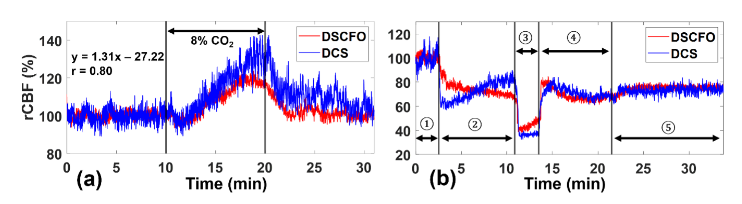
Fig. 7:  rCBF Measurements Results From Piglet #2 During Hypercapnia and Transient Global Cerebral Ischemia. (a) Time-course changes in rCBF during 8%CO2 inhalation, measured concurrently by the single-wavelength DSCFO probe on right hemisphere and single wavelength DCS probe on left hemisphere. Linear regression results between the two measurements: y = 1.31x – 27.22, r = 0.80. Here, x and y represent single-wavelength DSCFO and single-wavelength DCS measurements, respectively.(b) Time-course changes in rCBF during transient global ischemia measured concurrently by the two probes. ①: Baseline; ②: Left CCA ligation; ③: Bilateral ligation; ④: Releasing right ligation; ⑤: Releasing both ligations & recovery.


Click image to view full screen

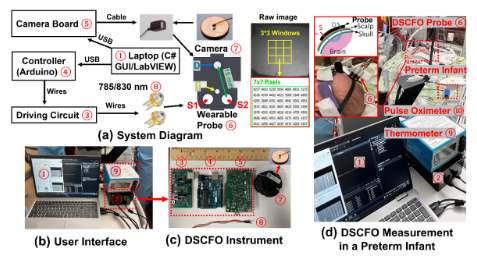
Fig. 8:  The DSCFO system for continuous cerebral monitoring of human preterm infants in the NICU.  (a) System diagram. (b)User Interface ①, DSCFO device ②, and a thermometer ⑨. (c) Components for DSCFO device including customized circuit ③ to drive laser diodes ⑧, Arduino Uno microcontroller ④, camera electronic (NanEye USB 2.0) ⑤, DSCFO probe ⑥, and NanEye camera ⑦. (d) DSCFO measurement in a preterm infant. A thermometer ⑨ was used to continuously detect skin temperature for safety. A pulse oximeter ⑩ was used to continuously measure SpO2. The DSCFO probe dimensions were 25 × 25 × 20 mm3. The source-detector (S-D) distances were 15 mm.

(Liu, Xuhui, et al. “Wearable fiber-free optical sensor for continuous monitoring of neonatal cerebral blood flow and oxygenation.” Pediatric research 96.2 (2024): 486-493.)

Click image to view full screen

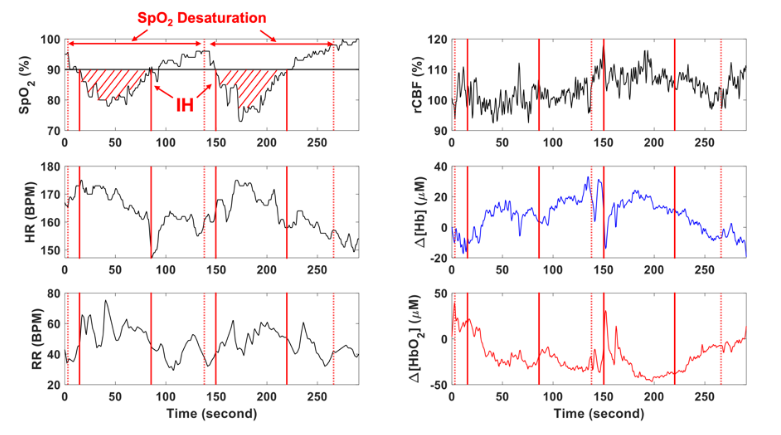
Fig. 9:  Measurement results from Infant #2.

(Liu, Xuhui, et al. “Wearable fiber-free optical sensor for continuous monitoring of neonatal cerebral blood flow and oxygenation.” Pediatric research 96.2 (2024): 486-493.)

DSCFO Video

Watch the DSCFO imaging system in real world usage scenarios

A low-cost, fiber-free, wearable diffuse speckle contrast flowmetry (DSCF) probe for continuous cerebral monitoring of freely behaving subjects